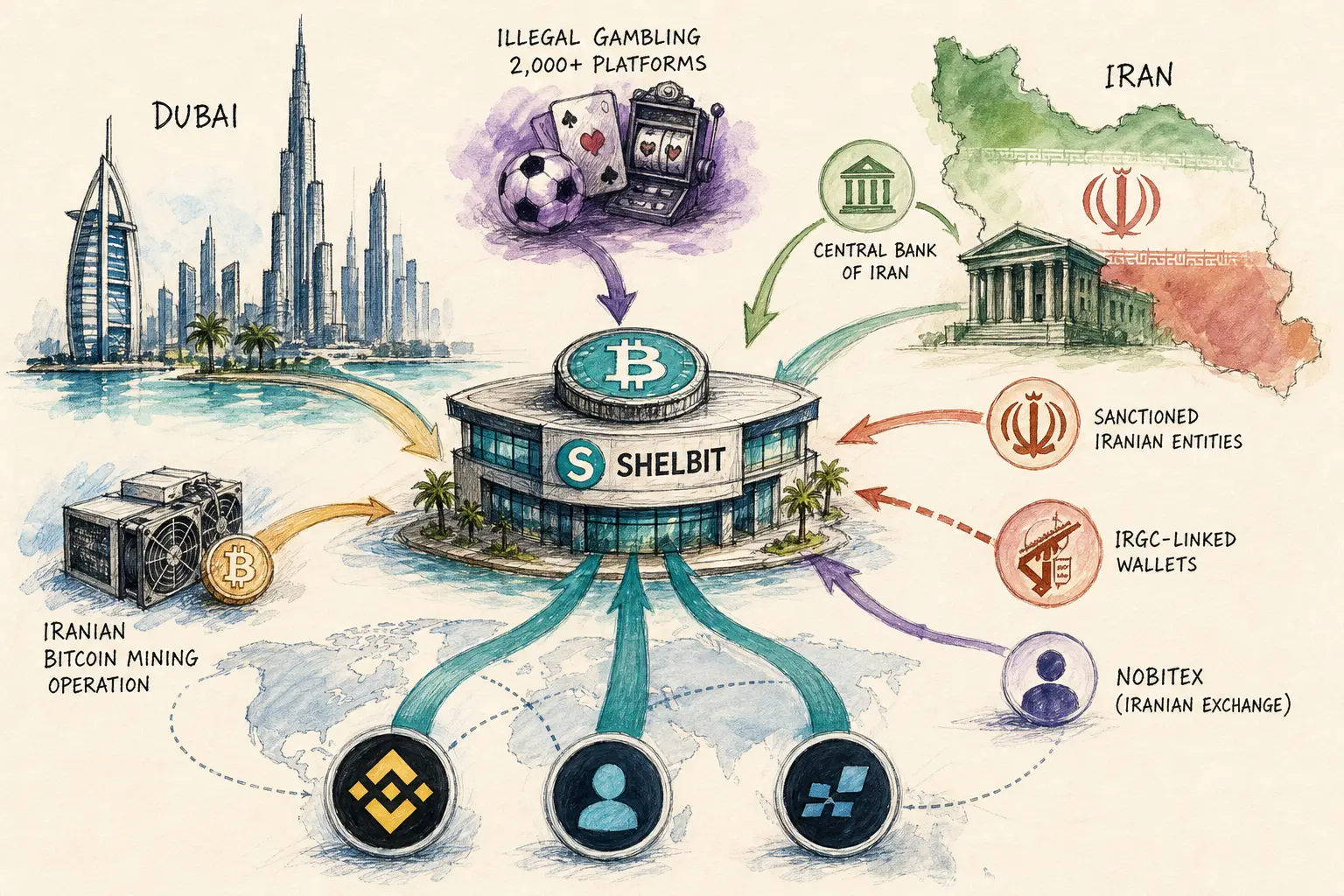
The key development is that Reuters says a Dubai-based crypto exchange, Shelbit, helped move money for a large Iranian sanctions-evasion network that also drew in an illegal gambling operation. That matters because the case shows how crypto infrastructure can connect businesses, sanctioned entities and global exchanges across borders.
What Reuters says Shelbit did
According to the report, Shelbit is an unlicensed exchange run by Iranian expatriate Siavash Kayvanpour. Reuters says it acted as a hub for a network that moved about $4 billion and that it sent hundreds of millions of dollars to major crypto platforms, including Binance.
The report says the network had ties to:
- a Dubai-based illegal gambling operation with more than 2,000 platforms
- Iran’s central bank
- other sanctioned Iranian entities
- wallets linked by the Israeli government to the Islamic Revolutionary Guard Corps (IRGC)
- Nobitex, an Iranian exchange sanctioned by the U.S. earlier this year
Why the network drew scrutiny
The concern is not only the size of the transfers, but the mix of actors involved. The Central Bank of Iran has been sanctioned since 2019 under U.S. counterterrorism authorities for support tied to the IRGC, its Quds Force and Hezbollah.
Reuters also reports that some of the crypto flowing into Shelbit came from what investigators described as an Iranian bitcoin mining operation. Bitcoin mining is the process of using computing power to create new coins and validate transactions.
What investigators and exchanges said
People who have studied illicit gambling and Iran-linked blockchain activity told Reuters the operation appeared unusually large.
John Wojcik, formerly a researcher at Infoblox and now a senior analyst at TRM Labs, called it one of the biggest Iranian illegal gambling networks ever discovered. Rich Sanders, an independent blockchain researcher focused on Iran, said the operation was an IRGC effort, though Reuters said it could not confirm direct IRGC control over Shelbit or the gambling network.
Binance told Reuters that Shelbit never had an account on its platform and that transfers linked to Shelbit were not treated as high risk. The exchange said it investigated related users, froze relevant accounts and reported them to law enforcement.
What is confirmed, and what is not
The reporting draws a clear line between allegations and verified control.
- Reuters says Shelbit was central to the money-moving network.
- Investigators and analysts believe the operation is closely tied to Iranian state interests.
- Reuters says it could not determine whether the IRGC directly controlled Shelbit or the gambling network.
That distinction matters because the evidence points to a sophisticated sanctions-evasion channel, but not to a documented command structure linking every part of it to the IRGC.
The broader takeaway
The case highlights how crypto rails can be used to move funds between high-risk operators, sanctioned actors and mainstream exchanges. For compliance teams, the practical challenge is not just identifying a single bad actor, but tracing how wallets, exchanges, gambling sites and state-linked entities can be layered together across jurisdictions.