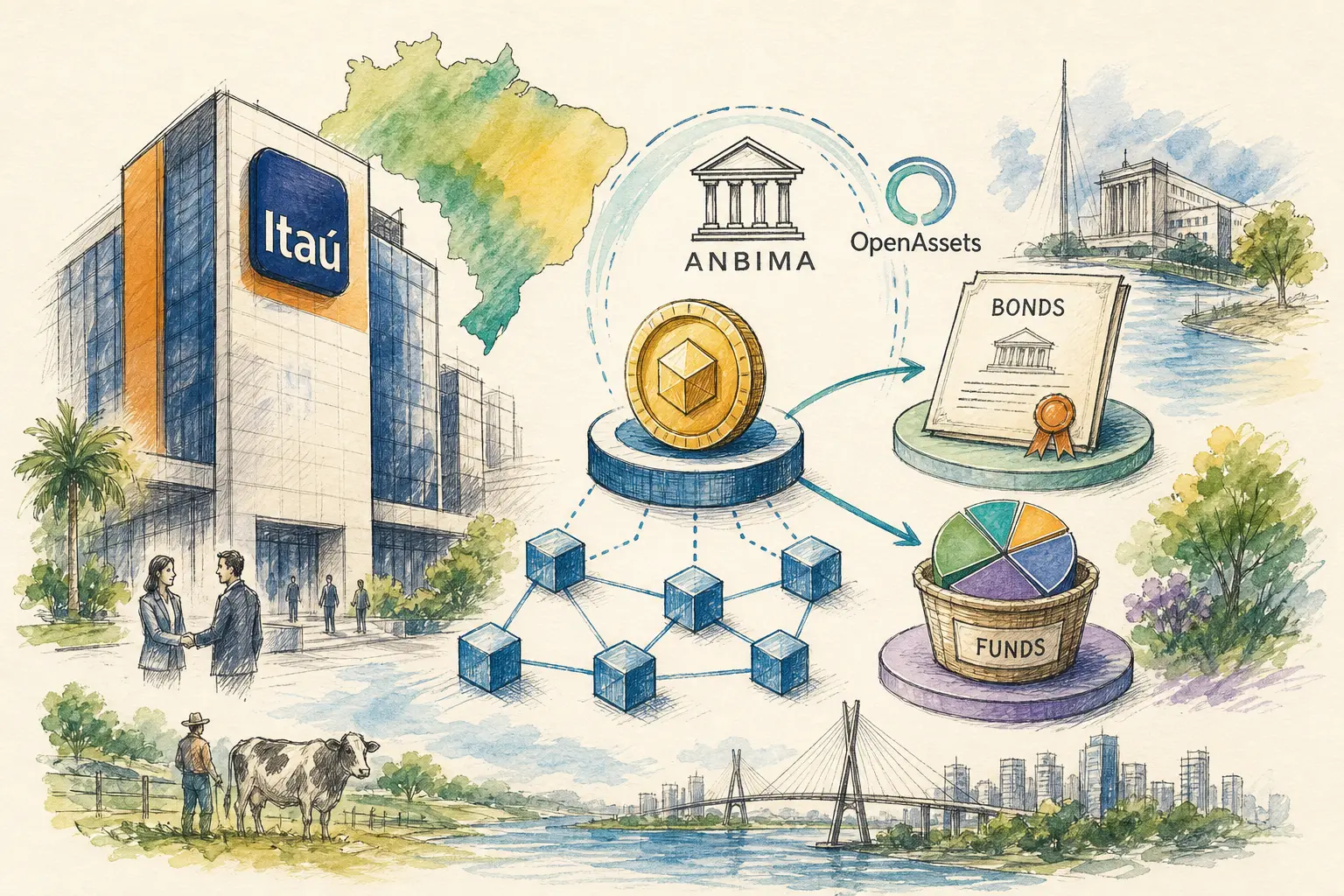
Brazil’s largest bank is moving further into tokenized assets, this time through a pilot that will test how traditional market products could run on blockchain infrastructure.
Itaú Unibanco has started working with digital-asset infrastructure provider OpenAssets on an initiative led by Brazil’s financial and capital markets association, ANBIMA. The project will examine tokenized fixed-income securities and investment funds, according to the companies.
What the pilot is trying to prove
The test is not just about putting assets on a blockchain. It will also look at the rules and technical standards needed for banks and asset managers to issue, trade and settle those instruments using distributed-ledger technology.
Distributed-ledger technology is a shared database system that records transactions across multiple participants rather than a single central server. In this context, tokenization means representing financial assets as digital tokens that can move on that system.
Why Itaú’s role matters
Itaú is Latin America’s largest lender, with more than $562 billion in total assets, according to S&P Global. Its participation gives the pilot a large institutional backer and adds to Brazil’s growing role as a live market for tokenized finance.
The bank is not new to this area. It was among the institutions selected by Brazil’s central bank in 2023 for the Drex pilot, which tested blockchain-based transactions involving tokenized money and assets.
Brazil has become a test bed
The broader Brazilian market has seen several tokenization efforts:
- VERT Capital said in July 2025 that it planned to tokenize up to $1 billion of debt and receivables on the XDC Network.
- Mercado Bitcoin said it would tokenize $200 million in assets on the XRP Ledger, including fixed-income and equity instruments.
- A separate project in Paraná explored tokenizing 10 cows to help farmers access trading and financing infrastructure.
Taken together, these experiments suggest Brazilian institutions are testing tokenization across both mainstream finance and less typical asset classes.
OpenAssets’ position in the market
OpenAssets said the initiative fits with its push to build tokenization infrastructure. The company raised $10 million last year in a round led by Valor Capital Group, with participation from Tether and members of the family that founded Itaú Unibanco.
For now, the key point is simple: one of Brazil’s biggest banks is helping test whether tokenization can move beyond theory and into regulated market use.
The bigger market context
Banks and asset managers globally have been experimenting with tokenized bonds, funds, private credit and equities. Tokenization has become one of the most closely watched blockchain applications in traditional finance because it could change how assets are issued and transferred.
The ANBIMA pilot does not settle that debate, but it gives Brazil another structured venue for assessing whether the model can work at institutional scale.