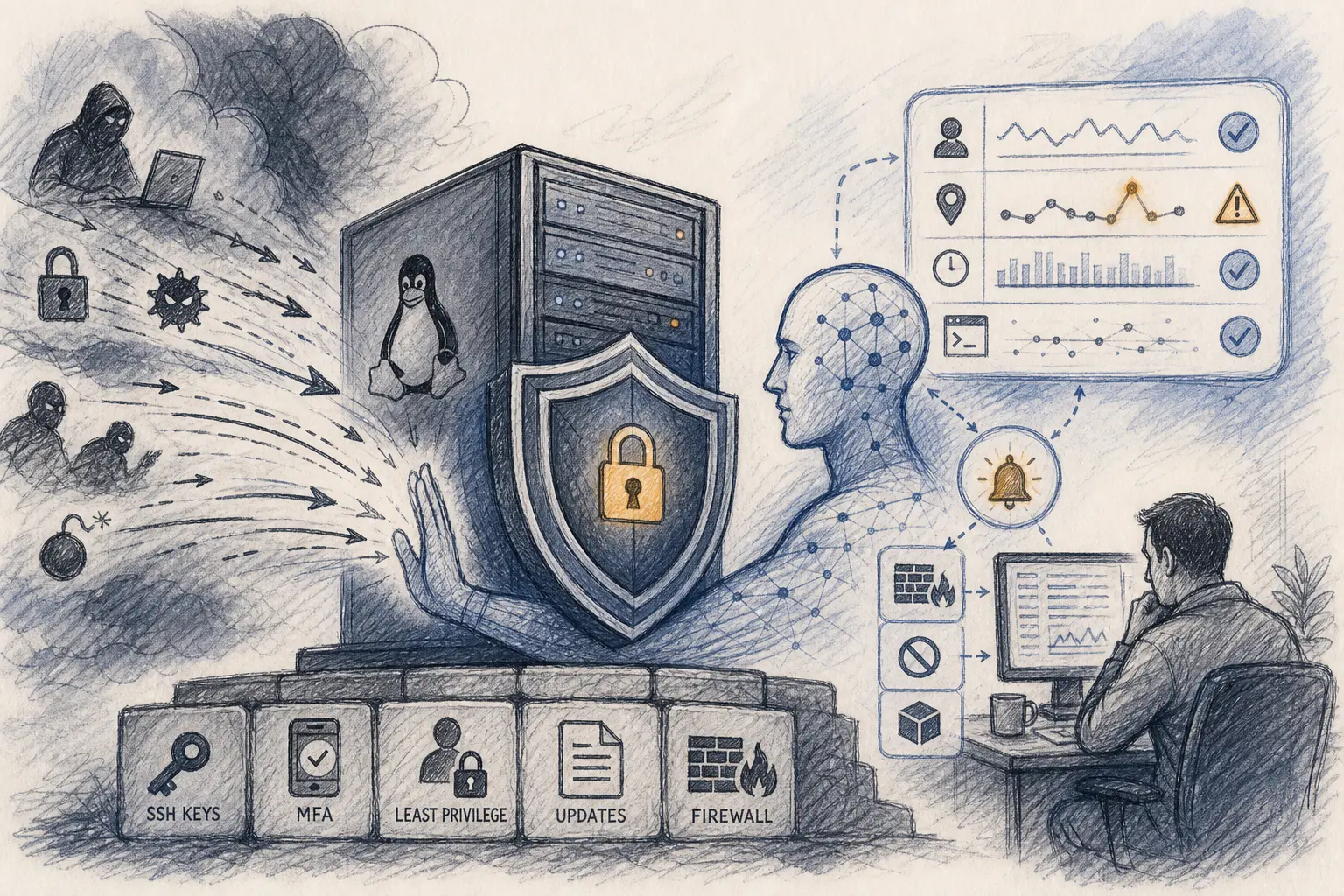
AI is becoming a practical addition to Linux VPS security because it can spot unusual behavior faster than fixed-rule tools alone. For businesses hosting websites, applications, or internal systems on a virtual private server (VPS), that can mean earlier warning signs, faster triage, and less manual log-watching.
Why AI fits server security
Traditional security tools usually rely on rules: block an IP after repeated failed logins, flag a file if it matches known malware, or alert when a threshold is crossed. Those approaches are useful, but they are strongest against threats that are already understood.
AI takes a broader view. It can compare logins, traffic, resource use, and other signals to the normal behavior of a specific server. That makes it better suited to noticing patterns that do not look obviously malicious one event at a time.
The main risks Linux VPS users still face
Linux has a strong security reputation, but a VPS is still exposed to common problems, including:
- brute-force login attempts
- malware introduced through unpatched software
- distributed denial-of-service (DDoS) attacks, which try to overwhelm a service and take it offline
- misconfigured permissions that leave data or systems exposed
- unauthorized access that starts quietly and goes unnoticed
The concern is often not a dramatic break-in. It is a small weakness that stays hidden long enough to cause damage later.
What AI can help detect
A useful example is an account that normally logs in from one region during business hours. If that same account suddenly logs in at 3 a.m. from a different location and starts accessing sensitive files, a rule-based system may only confirm that the password was valid.
An AI-based system can weigh the full context: time, location, account history, and what the user usually does after logging in. That context can help surface suspicious activity earlier.
AI can also support several routine security tasks:
Prioritizing updates
Keeping software patched remains one of the most effective defenses. The challenge is scale: even a modest server may have many packages installed, and not every update deserves the same urgency. AI tools can help identify outdated software, highlight patches tied to active threats, and reduce the time administrators spend deciding what to fix first.
Watching for subtle network changes
Attackers often probe a system before they act. That exploration can be easy to miss in logs, especially when there is a lot of traffic. Continuous monitoring of bandwidth, running processes, traffic patterns, and file changes gives AI more signals to compare against normal behavior.
Access control still matters most
None of these tools make weak account protection acceptable. SSH keys are safer than passwords, root login should be disabled where possible, multi-factor authentication should be used when supported, and permissions should follow the principle of least privilege, meaning each account gets only the access it needs.
AI does not replace those basics. Its value is in spotting when a login or action looks unusual even if the credentials were correct.
Faster response can limit damage
Security is not only about detection. It is also about how quickly a team can react.
AI-based systems can alert administrators, block suspicious IP addresses, isolate a compromised service, and assemble a report on what happened. That can buy time and reduce the amount of manual work needed during the first response.
AI is an aid, not an admin
The technology still depends on human oversight. Updates must be installed, firewalls must be configured, old software must be removed, backups must be created and tested, and audits must be performed regularly.
In other words, AI can improve visibility and speed, but it does not replace operational discipline.
The practical takeaway
For businesses running Linux VPS infrastructure, the most resilient setup still combines two things: strong basic administration and AI-assisted monitoring. The first keeps the environment sound; the second helps surface problems sooner and reduce response time.
That combination is where AI has the clearest value today: not as a stand-in for security work, but as a tool that makes existing security work more effective.