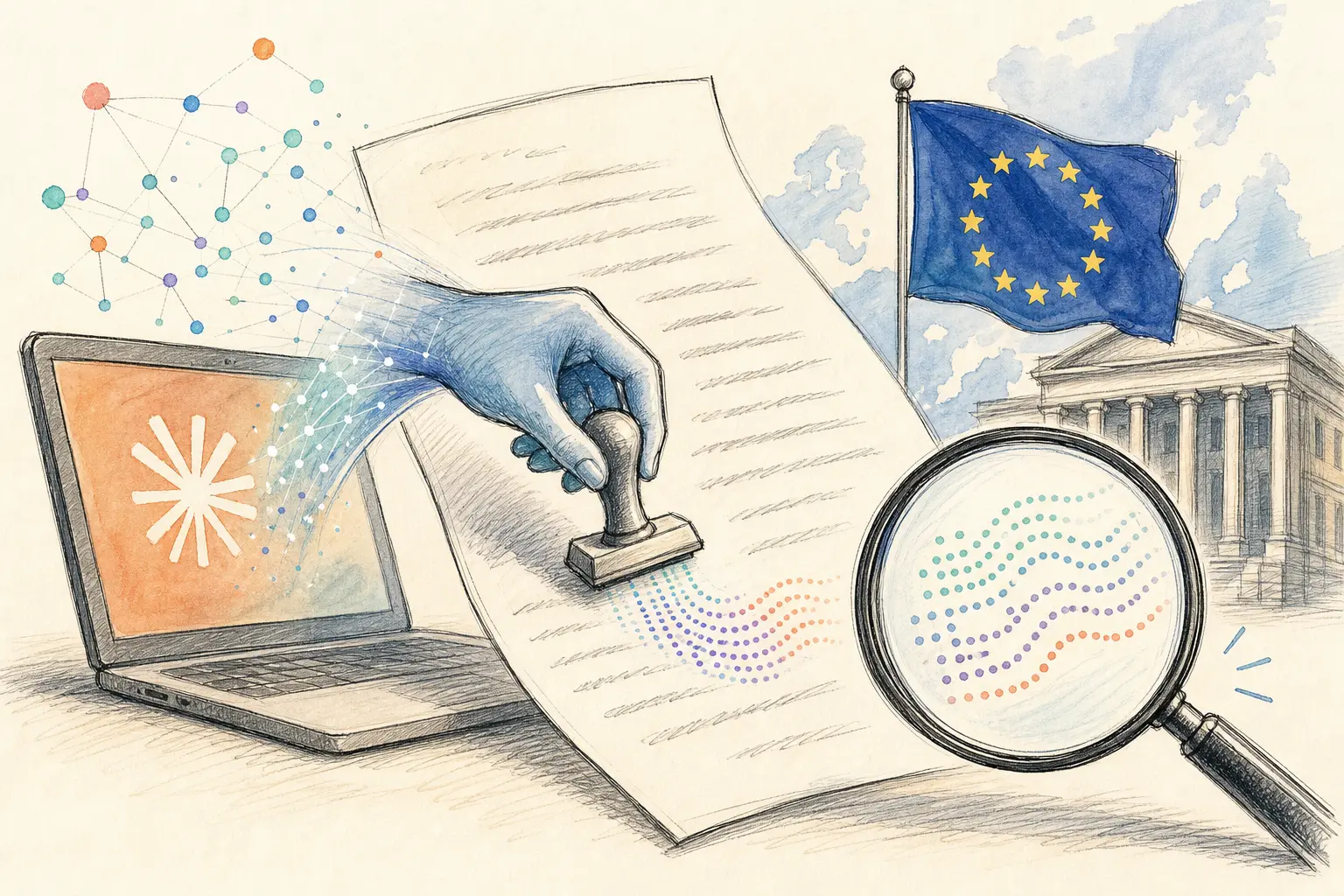
Anthropic says it will begin watermarking text generated by its AI models, including Claude, as it aligns with European transparency rules. The move matters because the watermark is meant to make AI-generated content machine-identifiable, not just readable by people.
What Anthropic is changing
According to an updated support page, all models released after August 2 will include watermarking for both generated text and files. For files, Anthropic says it is using the C2PA open standard, a framework for attaching provenance information to digital content.
The company also says it will extend the feature to older models.
Why the timing matters
The change maps to the European Union’s AI Act Transparency Code, which took effect on August 2. That code requires AI companies to mark AI-generated or AI-edited content in a way that other systems can detect.
In practice, that means Anthropic is building disclosure into the model itself rather than relying only on product-level labels.
How the watermark is expected to work
Anthropic says the watermark will travel with the text if users copy and paste it, and that it may survive some editing. The company says the watermark will be applied at the model level, so it will appear across Claude products and surfaces rather than only in one interface.
The support page says this will apply across products including the Claude platform API, Claude, Claude Code, Claude Cowork, and Claude Tag.
It is still unclear how much editing would be required to remove the watermark, and Anthropic has not publicly clarified that point.
Part of a wider industry response
Anthropic is not the only company moving in this direction. Other companies, including Black Forest Labs, Google, Meta, Microsoft, OpenAI, and Synthesia, have said they will follow the EU code.
The broader pattern suggests AI providers are increasingly treating content labeling as both a regulatory requirement and a product issue, especially as users and platforms push for clearer disclosure of machine-generated material.