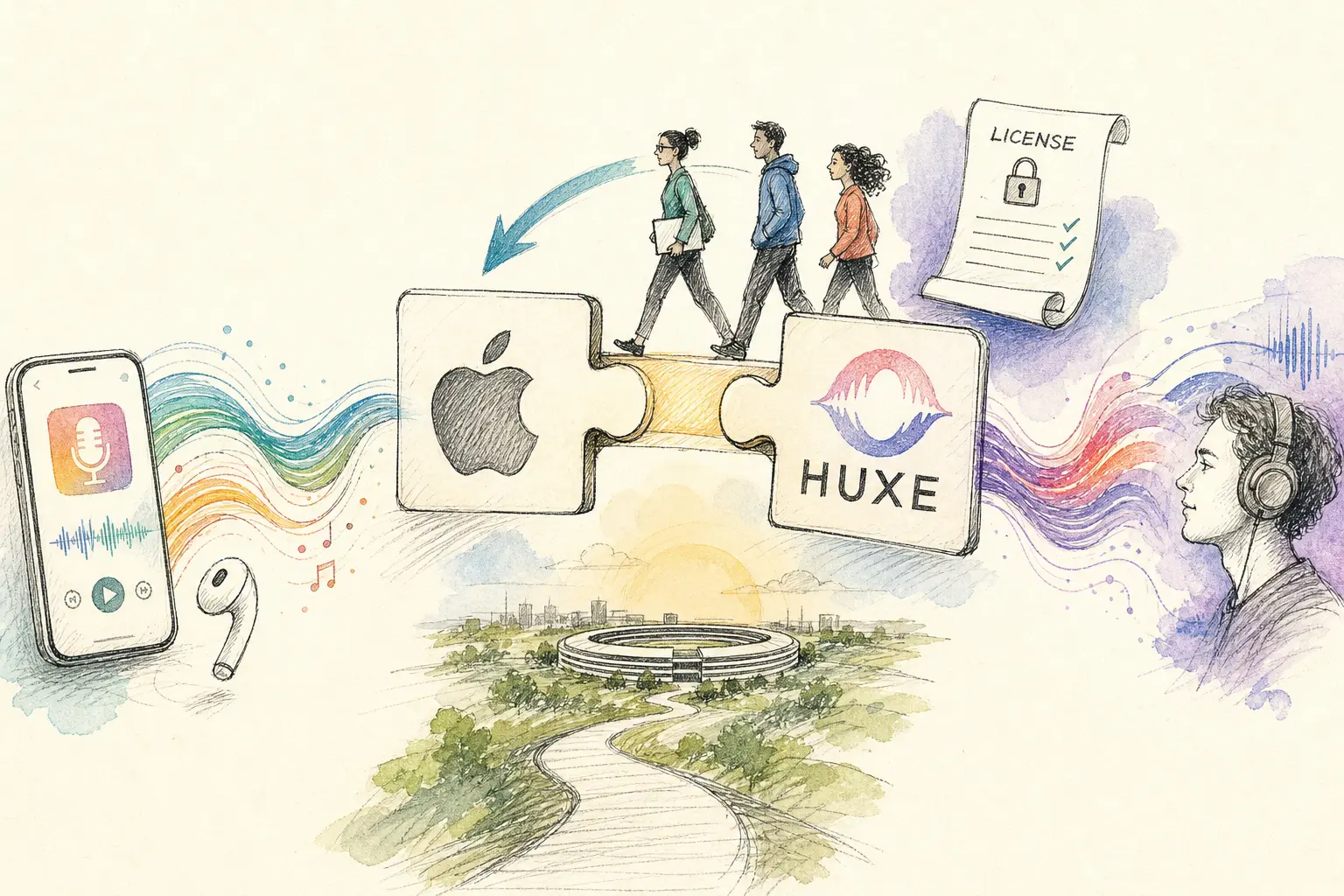
Apple has disclosed that it plans to bring on some employees from personalized audio startup Huxe and license the company’s intellectual property. The move matters because it gives Apple access to both talent and technology without buying the startup outright.
What Apple disclosed
In a regulatory filing to the European Commission, Apple said it has agreed to:
- make employment offers to “certain employees of Huxe AI”
- receive a non-exclusive license to Huxe’s intellectual property rights
A non-exclusive license lets Apple use the technology while Huxe could, in principle, license it to others too.
Why this kind of deal is notable
This structure is often called a reverse acqui-hire. In practice, that means a larger company hires key people and licenses startup technology instead of acquiring the whole company. The approach has become more common as tech companies look for talent and product know-how while potentially avoiding some of the scrutiny that can follow a full acquisition.
What happened to Huxe
Huxe was founded by developers who previously worked on AI-generated podcast features in NotebookLM, which has since been renamed Gemini Notebook.
The startup said on May 21 that it was shutting down. It told users it would remove its app from the Apple and Google app stores, stop service, and delete user data. Huxe also said the team was moving on and that development would not continue.
Apple notified the European Commission of the deal on June 9, shortly after Huxe’s shutdown announcement.
What is still unknown
The filing does not say which employees received offers or whether they accepted. It also does not explain what Apple plans to do with the licensed technology.
That leaves the most important question open: whether Apple intends to use Huxe’s work in its Podcasts app or somewhere else. That possibility is plausible, but not confirmed by the filing.
Why readers should watch this
The deal shows how AI features can move from startups to big platform companies through hiring and licensing rather than a headline acquisition. In audio, that matters because personalized, AI-generated formats are increasingly part of the competitive landscape, and Apple appears to be positioning itself to participate without saying exactly how.