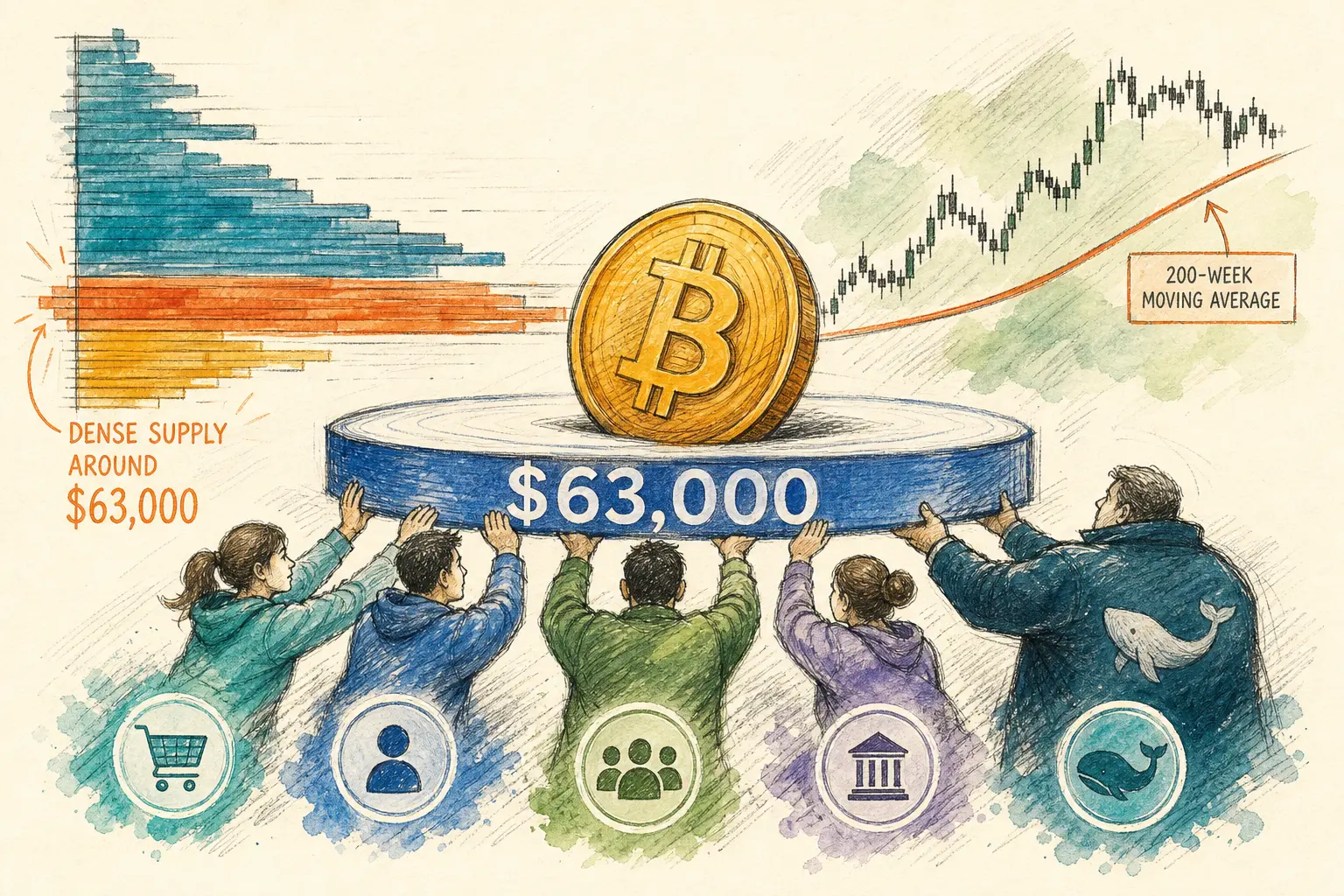
Bitcoin’s $63,000 area has become a major test for buyers because a large amount of supply is clustered there and accumulation is still showing across wallet sizes. Glassnode says the market is trading close to its 200-week moving average, a long-term trend gauge that often helps frame support and resistance.
A crowded price band
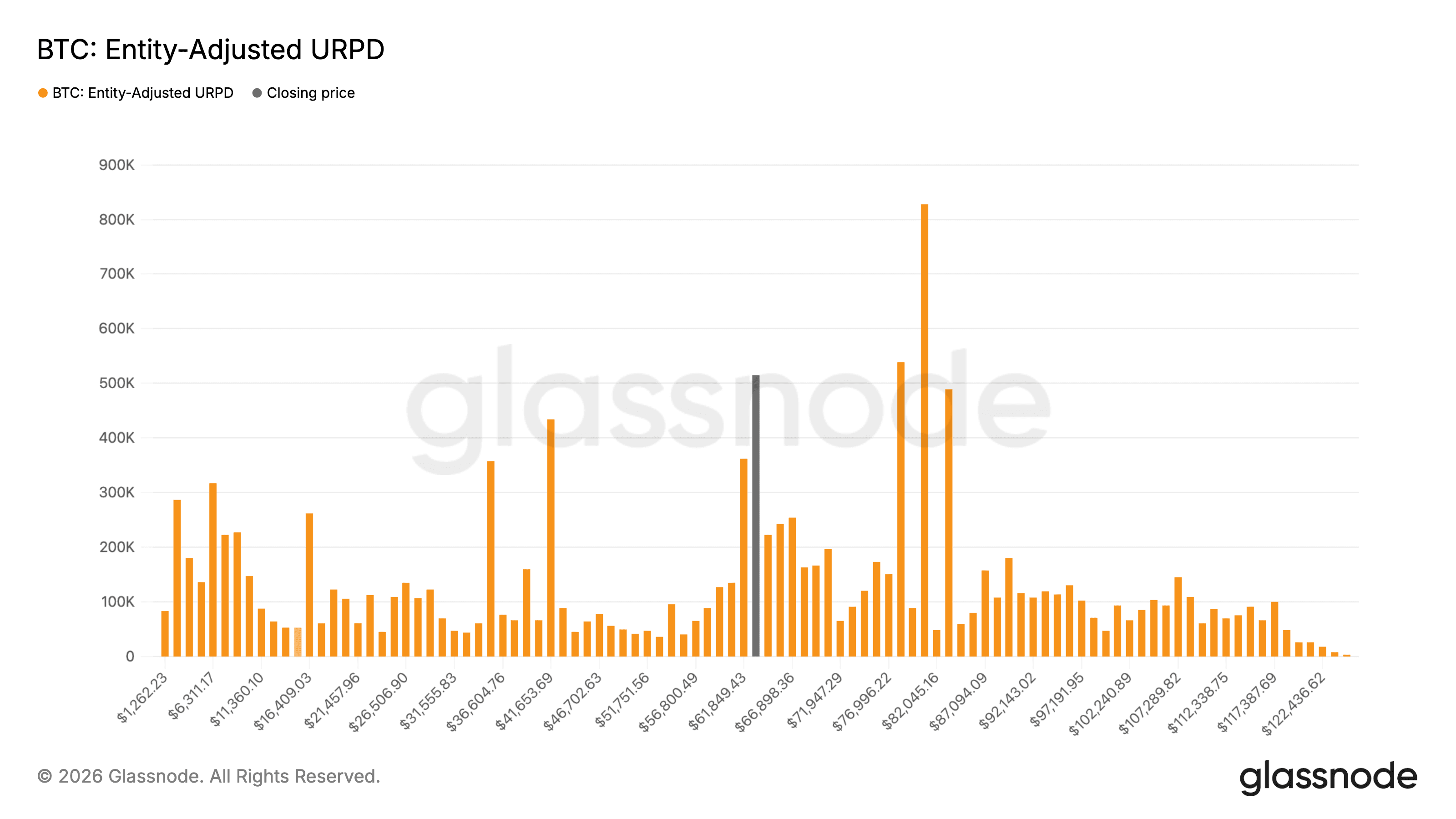
Bitcoin has spent several weeks moving between $60,000 and $67,000. Within that range, Glassnode’s Entity-Adjusted UTXO Realized Price Distribution, or URPD, shows a heavy concentration of coins that last changed hands around $63,000.
URPD is an on-chain measure that groups bitcoin supply by the price at which it was last moved. In this case, more than 3% of circulating supply — about 515,000 BTC — is clustered near $63,000. Another large pocket, more than 2% or roughly 362,000 BTC, sits around $61,000.
That matters because price zones with large supply clusters often become areas where market participants may react, either by buying dips or selling into rallies.
The 200-week moving average is close by
Bitcoin is also trading almost exactly at its 200-week moving average, which currently stands at $63,657. At the time cited by Glassnode, bitcoin was at $63,822.
A moving average smooths price data over time. The 200-week version is watched closely because it reflects bitcoin’s average weekly price over a very long period and is often used to judge the broader trend.
Buyers are active across cohorts
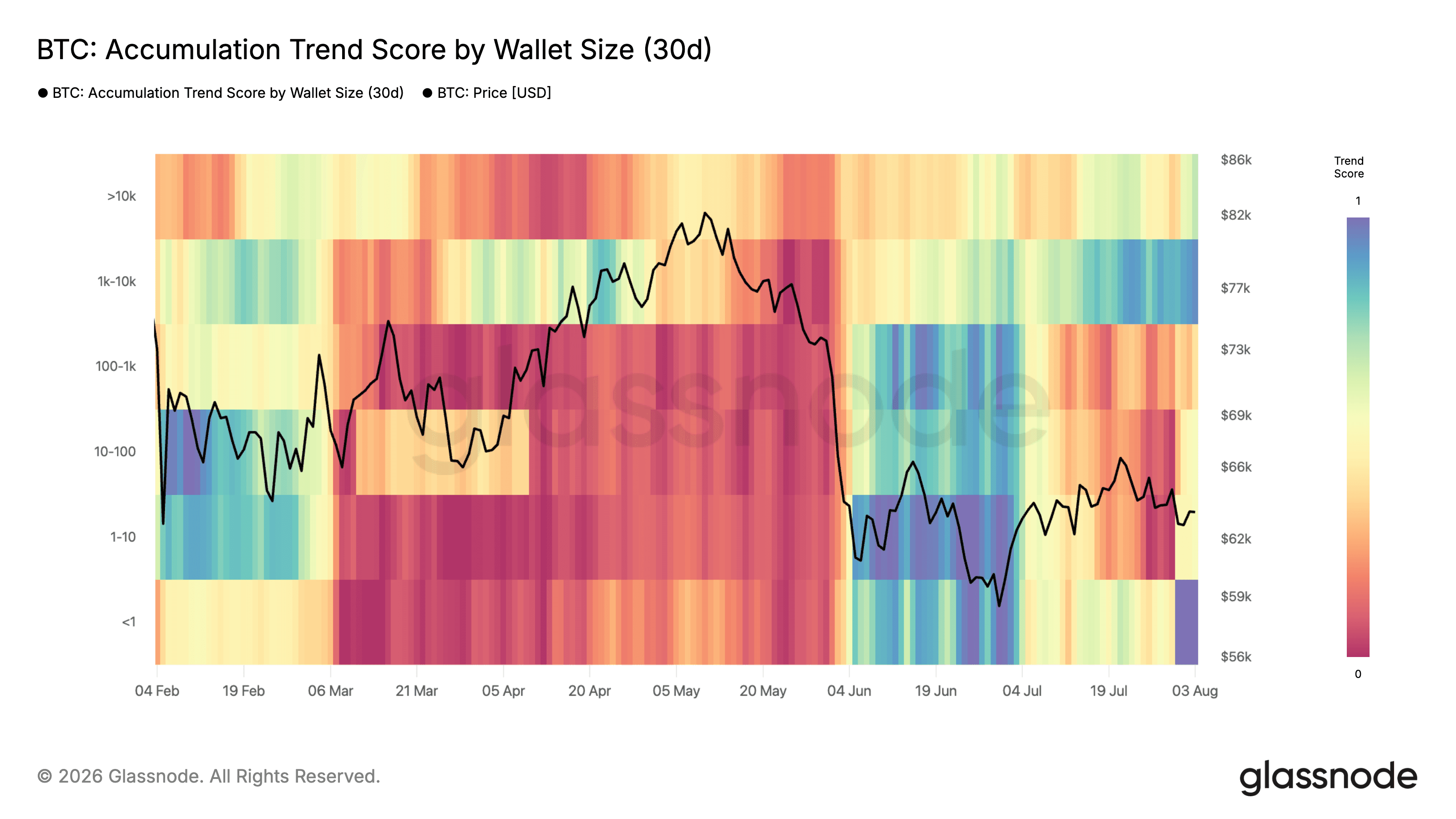
Glassnode’s 30-day Accumulation Trend Score, which tracks whether different wallet-size groups are adding to or reducing holdings over the past month, suggests buying is not limited to one segment of the market.
- Retail investors are the most aggressive buyers at current levels.
- Other wallet cohorts are also accumulating.
- Whales, defined here as holders of at least 1,000 BTC, are also showing strong accumulation.
The combination of heavy supply at $63,000 and broad accumulation implies that this price zone is acting as a key battleground: buyers appear willing to absorb supply, but the market still has a dense overhead and nearby supply base to work through.